
Do you know your 10-year heart risk?
Most heart attacks strike people who felt fine the day before. This clinically validated ACC/AHA Cardiac Risk Index estimates your 10-year risk of heart attack and stroke in under a minute, then shows you how the Hume Band 2.0 tracks the heart signals behind that number, every second of every day.
Cardiac Risk Index
10-year heart attack & stroke risk · ACC/AHA
Four risk tiers clinicians use
Your 10-year risk is the probability of a first heart attack or stroke over the next decade. Here's how cardiologists read the score.
Your heart risk is well controlled. The goal now is to keep it there: small daily habits protect the years you've earned.
Risk is starting to build. This is the window where lifestyle changes and closer monitoring make the biggest difference.
A meaningful risk that warrants action. Clinicians often discuss risk-lowering steps and consistent tracking at this level.
Elevated risk that deserves a conversation with your doctor. Daily heart monitoring helps you and your clinician act sooner.
This Cardiac Risk Index provides estimates for general educational purposes only, using the ACC/AHA 2013 Pooled Cohort Equations. Results are not a diagnosis and are validated only for adults aged 40–79 without existing cardiovascular disease. Your true risk depends on many factors this tool does not capture. It is not medical advice. Always consult a qualified healthcare provider about your heart health.

A risk score is a snapshot. Your heart is a live signal.
The calculator estimates your risk from a handful of numbers you measure once or twice a year. The Hume Band 2.0 reads the signals behind that risk continuously: resting heart rate, heart-rate variability, blood-pressure trends and blood oxygen, every second on your wrist.
So instead of finding out something changed at your next appointment, you see it the day it starts.
The heart signals your risk score can't see
Your Cardiac Risk Index uses static inputs. These are the living metrics the Band 2.0 tracks around the clock to reveal how your heart is really doing.
Heart-rate variability
HRV is one of the earliest signals of cardiovascular strain. The Band reads it continuously so you spot dips before they become problems.
Blood-pressure trends
Cuff-free daily insights into the single biggest driver of the ASCVD score, tracked as a trend, not a one-off reading in a clinic.
Resting heart rate
A rising resting heart rate can signal your cardiovascular system is under load. See your baseline and every shift from it, 24/7.
Early risk alerts
The Band flags unusual heart patterns early: 69% of the heart-risk alerts it surfaced were later confirmed by a doctor.

See your heart's real range, not just a once-a-year snapshot
The Hume app maps your resting heart rate against your HRV every day, so you can see when your heart is in its optimal zone and when it's drifting out of it. Persistent deviations are often the earliest warning of cardiac stress.
It's the difference between a number you calculate once a year and a system watching your heart every single day.
Explore the tech →Protect your heart with real data
Continuous heart tracking
Resting heart rate, HRV and cardiovascular stress read every second, so the signals behind your risk score are never a mystery until your next check-up.

Recovery & strain
See how much load your body is under and whether it's recovering. Chronic strain without recovery is one of the quiet drivers of heart risk.
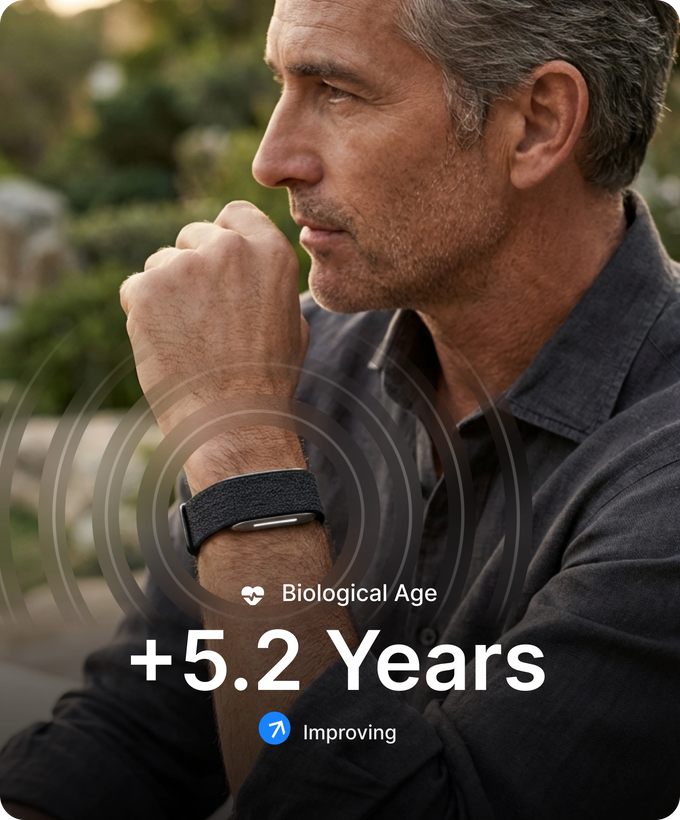
Biological age
Your heart health is a major driver of how fast you're really aging. Track your biological age and watch it respond as your habits improve.
Built by scientists. Trusted for what matters most.
of the heart-risk alerts the Band surfaced were later confirmed by a doctor.
of users noticed warning signals from their body before they ever felt sick.
five-star reviews from people who stopped guessing about their heart.
"My risk score looked fine on paper. The Band caught a resting heart rate creeping up for weeks. My doctor took it seriously, and we caught it early."Verified Hume Band member
Your heart risk, answered
What exactly does my Cardiac Risk Index score mean?
I don't know my cholesterol numbers. What should I enter?
How does the Hume Band 2.0 actually help my heart?
Is there a subscription?
You know your number. Now watch the heart behind it.
Turn a once-a-year risk estimate into 24/7 heart insight with the wearable built to protect your heart.
Get the Hume Band 2.0 →