
How many calories do you burn walking?
Most step trackers just multiply your steps by a flat guess. This calculator uses your weight, pace and incline — the three things that actually move the number — to estimate calories burned, distance, steps and fat loss for any walk.
Walking Calorie Calculator
Calories · distance · steps · fat loss
Calories burned on a 30-minute walk
A quick reference for a 155 lb (70 kg) walker. Notice how much the incline column climbs — grade matters as much as pace.
| Pace | Flat (0%) | Gentle hill (5%) | Steep (10%) |
|---|---|---|---|
| 2.5 mph · casual | 108 kcal | 171 kcal | 235 kcal |
| 3.0 mph · moderate | 122 kcal | 198 kcal | 275 kcal |
| 3.5 mph · brisk | 136 kcal | 225 kcal | 314 kcal |
| 4.0 mph · fast | 150 kcal | 252 kcal | 354 kcal |
Figures are calculated with the same ACSM equation as the calculator above, for a 155 lb / 70 kg person walking 30 minutes. Heavier walkers burn proportionally more; lighter walkers, less. Use the calculator for your own numbers.
What actually decides how much you burn
Every walking-calorie formula comes down to these inputs. Change any one and your total moves.
Body weight
You burn energy moving your own mass, so a heavier body burns more over the same walk. Weight scales the whole result up or down almost linearly.
Pace / speed
Faster walking demands more oxygen per minute, raising your MET value. Going from a 2.5 mph amble to a 4 mph power walk lifts your burn by roughly 40%.
Incline / grade
Lifting yourself against gravity is expensive. Adding a 5–10% grade can add 50–130% to your burn versus flat ground at the very same speed.
Time or distance
Energy cost accumulates with every minute on your feet. Whether you track a duration or a distance, longer walks burn more — the calculator handles both.
How the calculator works
No black box. Here's the exact physiology the tool runs, step by step.
Convert your inputs. Weight is converted to kilograms and your pace to metres per minute, so the physics works regardless of imperial or metric.
Find your oxygen cost. The ACSM equation turns speed and incline into VO₂ — how much oxygen your body uses per kilo, per minute, to keep walking.
Turn oxygen into calories. One litre of oxygen releases about 5 kcal, so calories = VO₂ × your weight × time. Divide VO₂ by 3.5 and you also get your MET intensity.
Estimate fat loss. Roughly 3,500 kcal equals one pound of fat, so the tool converts your burn into grams of fat used on that walk.
The same walk, more than double the burn
A brisk 3.5 mph walk on flat ground burns about 136 kcal in 30 minutes. Tilt that to a 10% grade — a moderate hill or treadmill setting — and the same half hour burns around 314 kcal.
That's more than many people burn jogging, with far less impact on your knees and joints. If you want more from the same time, add incline before you add speed.
Try It in the Calculator ↑
A calculator estimates. Your wrist can measure.
This tool gives you a solid estimate from three numbers. But no formula can see your heart rate spike on the hill, or how hard your body is really working today. The Hume Band 2.0 reads heart rate, HRV, skin temperature, SpO2 and blood pressure every second to show your true burn on every walk.
Steps, distance, active minutes and calories — tracked automatically, 24/7, no phone required.
What the Band tracks that a formula can't
The calculator is a starting point. These are the live signals that turn a rough number into a plan you can trust.

Your real calorie burn
Heart rate, steps, active zone minutes, distance and calories logged automatically. You see what today's walk actually cost you — not a table's best guess.

Strain & recovery
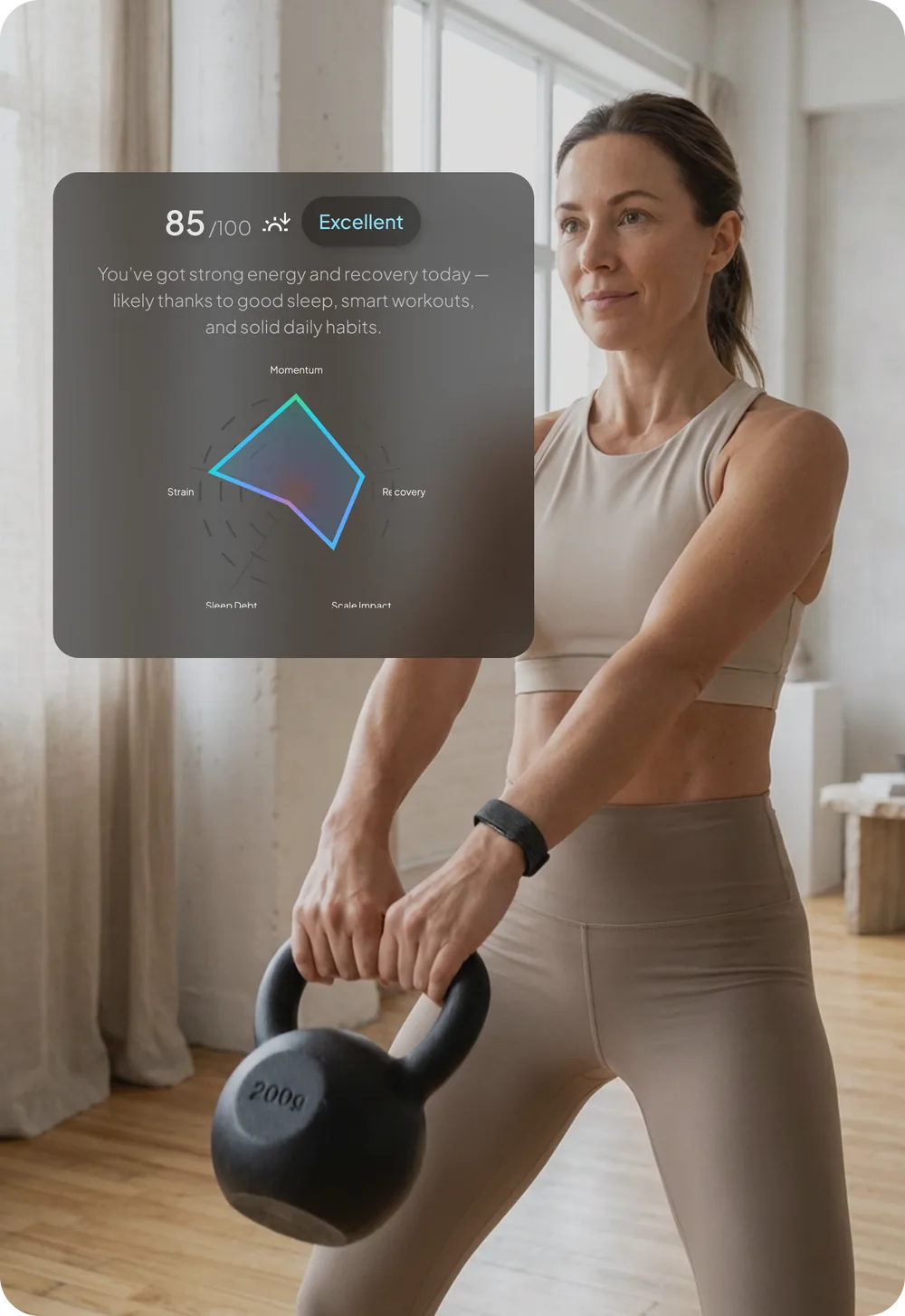
Metabolic capacity shows how much your body can handle each day, so you know when to push the pace uphill and when an easy flat walk is smarter.
Coaching that adapts
Your AI coach reads your biomarkers and sets step and recovery targets tuned to you — not a population average pulled from a chart.
Walking calorie questions
How accurate is a walking calorie calculator?
Do you really burn more walking uphill?
Is it better to walk faster or longer to burn more?
How does the Hume Band 2.0 measure my walking burn?
Stop estimating your walks. Start measuring them.
Turn the number above into 24/7 insight with the wearable built to extend your lifespan.
Get the Hume Band 2.0 →